
Atotô
August with Omolu in Candomblé

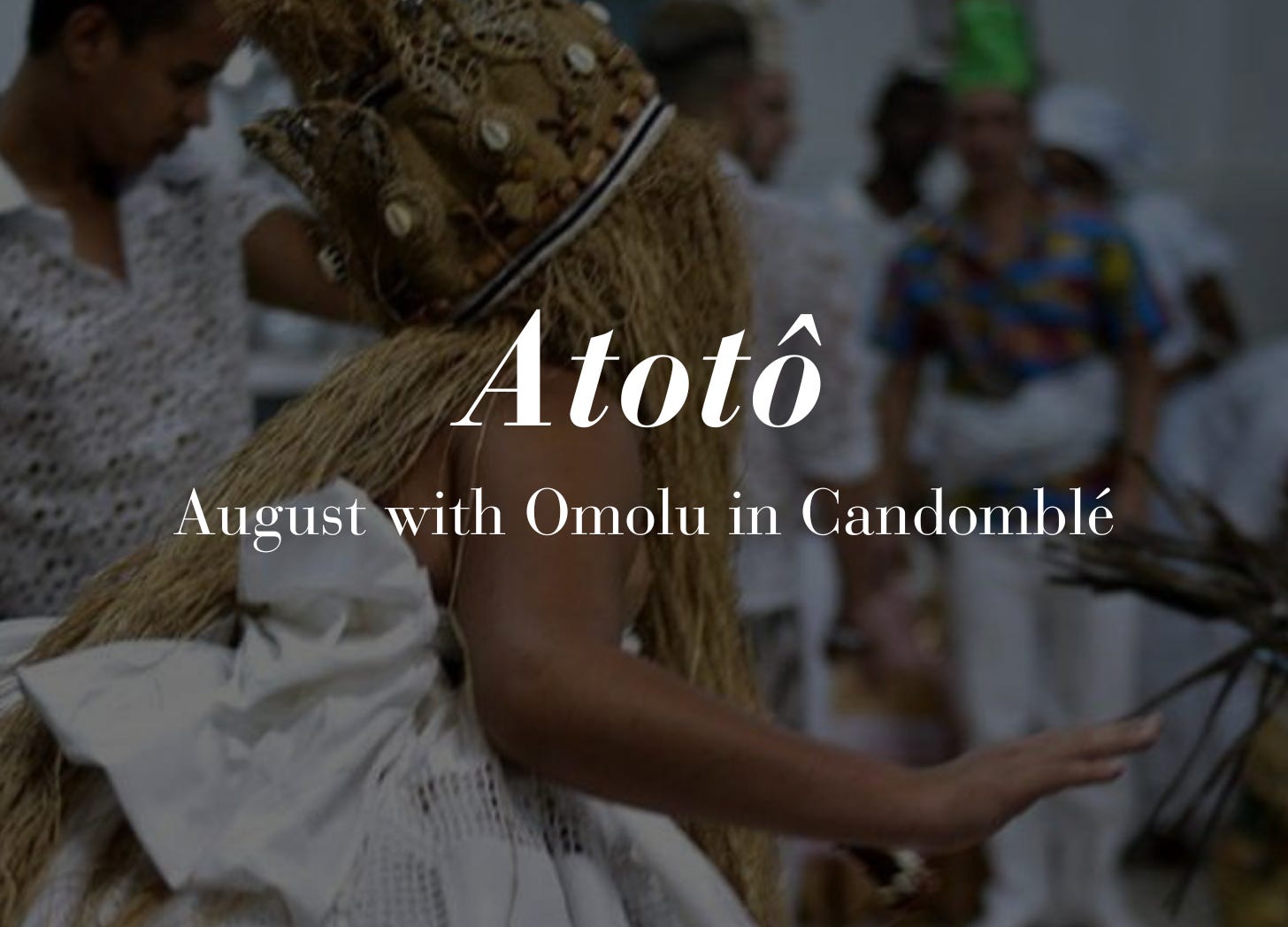
Every August, homes, terreiros and communities throughout Brazil begin preparing offerings for one of the most beloved and deeply respected Orisha in Candomblé: Omolu.
To many people outside of the tradition, he is known only as the Orisha of illness or disease. But to those who walk with him, Omolu is so much more than that. He is the Orisha who governs the mysteries of life, death, healing, transformation and the passage of time itself. He is the medicine that only lived experience can offer. Omolu represents the wisdom that comes after surviving what you once believed would break you.
He reminds us that healing is rarely immediate. It unfolds slowly, layer by layer, season by season— until one day we realize we have become someone entirely different than who we once were. That is why we honor him throughout the month of August.
It is a time to pray for health, longevity, protection, resilience and the strength to endure life’s inevitable transformations with strength & dignity.
In Candomblé, Omolu (and Obaluaiê) is intimately connected with the earth itself, we call him the King of The Earth.
Not the lush forest of Oxóssi, not the rushing waters of Oxum or the crashing ocean of Yemanjá– When we talk of Omolu, we are talking about the earth that receives us when we fall. The soil where seeds decompose before they sprout. The dust that reminds us we are ephemeral and mortal. Omolu is the ground that receives our ancestors and transforms death into new life. His depth reaches the center, the core of earth herself.
Omolu governs cemeteries, sacred healing grounds, hospitals, places of recovery, quarantine and thresholds between worlds. Wherever there is profound transformation through suffering, Omolu is present.
He is not only the Orisha of sickness, he is also the Orisha of recovery. He teaches us that illness—whether physical, emotional, ancestral or spiritual—can become a doorway into wisdom.
One of the best-known stories about Omolu talks of a child abandoned because his body was covered in sores and lesions. In many retellings, he was afflicted with leprosy. Ashamed of his appearance, he concealed himself beneath a garment woven from straw, hiding both his wounds and his identity.
People feared him. Avoided him and rejected him.
Until one day, during a great celebration, the winds of Iansã (Oyá) lifted the straw that covered his body. Instead of the diseased child everyone expected to see, they witnessed something miraculous. His wounds had transformed into brilliant lights. The scars themselves had become beauty. The one who had been rejected was revealed to be a king.
This pataki—or sacred story, told in different forms across the African diaspora—is not merely about physical healing.
It is about dignity.
It reminds us that our deepest wounds often become the places from which our greatest medicine emerges. Many of us spend years hiding the parts of ourselves we believe make us unworthy. Omolu teaches that these very places may one day become our greatest offering to the world.
Atotô

Feeling called to go deeper?
If something in this essay resonated with you, I invite you to keep following the golden thread.
Everything we’ve built at Yabisi is designed to support the lifelong practice of remembrance—meeting you wherever you are on your path.
✺ Start Here with our free essays, meditations, classes and resources.
✺ Join The House of Remembrance, our monthly membership with a growing library of teachings, live classes, rituals and community.
✺ Explore The School of Remembrance, our immersive year-long training for those ready to deepen their practice.
✺ Visit Botánica Yabisi for ritual tools, microdose protocols, flower essences and botanical medicines crafted to support your spiritual journey.
✺ Listen to The Woo Podcast for conversations on spirituality, herbalism and ritual across the diaspora.
There is no right place to begin.
Only the place that’s calling you.
Welcome ~